














|

Let There Be Light:
Interview with Lora DeVore
By Carin Chea
With grace and poise, Lora DeVore often speaks to the masses who are hurting. But, it is neither her quiet confidence nor her impressive credentials that disarms and enthralls audiences.
It is DeVore's true story and her unfettered willingness to share it that silences doubting minds.
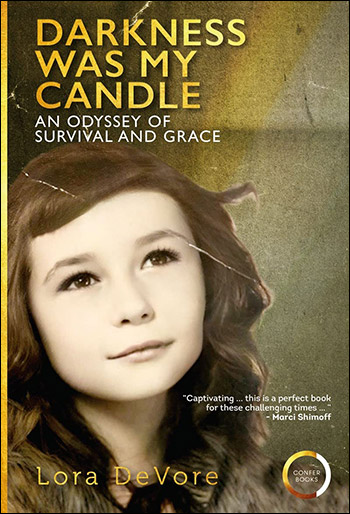
DeVore's autobiography, Darkness Was My Candle: An Odyssey of Survival and Grace, is a journey through unspeakable horrors, but (most importantly) the unparalleled strength and tenacity of one woman's spirit.
You have heard the phrase, "Our next guest needs no introduction." But, truly, no proper introduction could ever do this remarkable guest justice.
I don't know where to begin. You are one of the most extraordinary, resilient individuals I have ever met. How do you think we should start?
I'm considered a visionary leader and speaker. I've talked to groups of thousands. It can be a little scary, but I push myself forward, knowing I'm no longer a high-school student who failed sophomore speech, not once but twice. For many years, people have told me I'm a powerful storyteller.
I've also worked for The Center for Mind-Body Medicine out of Washington DC. That work has taken me around the world. We've worked with firefighters after 9-11 and I've worked in Haiti, and Parkland, Florida. I know trauma as a professional. I know it from the inside out having experienced it.
There's a saying: "Facts inform, stories enlighten." In my talks, I've always naturally used storytelling. I have witnessed how stories shift consciousness. I've had amazing experiences since beginning to write my book.
For years I had lived a double life. I was respected professionally, but I had this past I seldom shared with anybody. Back in therapy I shared a lot, but then I just let go of that history. But I always wondered if people really knew me, what would they think.
So over time as I dug deep in the writing of Darkness Was My Candle, I began to share bits and pieces of more of me other than my professional identity. I've received powerful feedback that a story I shared here and there was inspiring and gave others hope and at the same time became deeply healing and integrative for me as well.
I didn't set out to write the book coming out on April 5th. Initially, I was writing more of a spiritual autobiography. One summer I was doing some research for my writing mentor, Deena Metzger, in preparation for a trip to the Yakama Reservation to interview elders for a book she was writing and to accompany her in visiting Hanford Nuclear Site in Washington, State.
Hanford is one of the most toxic places in the US. They mine uranium and plutonium that went into making the atomic bomb. They bury all the waste from nuclear ships there. It's a very creepy place to visit, and everything is dead. There's not a thing that is alive there. There's not a bird in the air or a tree alive.
The nuclear waste has been going into the ground water for some time poisoning the salmon. The farmers living downwind have experienced very high incidents of cancer, and so are the residents of the nearby Yakama reservation. It made me more conscious of so much that's been hidden and of what we've done.
The research took me to a government report titled, "American guinea pigs. Three decades of radiation experiments on U.S. citizens," Congressional Subcommittee on Energy Conservation and Power, Published in 1986.
This report cited radiation experiments conducted on human subjects without their knowledge or consent. Horrified, I continued to read and then unexpectedly, the name of an institution to which I had been committed the summer after my freshman year in college appeared on the screen in front of me - Elgin State Hospital. It stopped me cold.
Elgin was a piece of my past that I had no desire to ever revisit. I read that there had been a time in which ANL-1 Radium was being given as an experimental treatment to patients at Elgin State Hospital between 1931 and 1933. Although this was long before I had been a patient there, it nonetheless shook me to my core.
Later that day Deena asked me how the research was going. I shrugged and answered, okay. But Deena picked up that something was going on and asked me to tell her. I explained that reading the research was hard and that it portrayed a dark history of our country.
She probed a little further until I hesitantly explained that the state hospital to which I had been committed had come up on screen and shook me. Deena asked why she had never heard that I'd been in a state hospital.
In that moment, I realized I still carried a sense of shame about that time in my life. She had no idea I had been institutionalized, nor did most of my closest friends.

Can you tell me about that?
I was committed to a state hospital the summer after my freshman year in college. It would soon become clear I needed to write about it. But for years, I had shut down and stored the memories and trauma of that time and place in an inner vault.
Other than therapy, I had seldom if ever told anyone. It was a horrific time in my life. I had gone off to college in Chicago. It was a hard year. Having moved around a good bit in high school and homeless the month before graduation, I didn't even know I was supposed to sign up for a dorm. I moved three times.
By the end of that year, I was now in a dorm. I worked weekends as a nursing assistant and was being stalked by a respiratory therapist at the hospital. After he showed up at the bottom of my subway stop and tried to pull me into his car, I quit my job out of terror. Now, I had no job and nowhere to go when they were closing the dorm for cleaning.
My old default as a kid when I felt trapped was to attempt kill myself, so I took a bottle of aspirin. Quickly, I thought that was stupid and made myself throw up. I talked to my dorm mother who sent me across town to get medically checked out and assured me that I could come back to the dorm and she'd help me find another job and somewhere to live.
The emergency room sent me across town to Illinois State Psychiatric Institute "for a couple of days to sort things out." I was placed on a young adult ward where all the patients had no family support.
I learned many decades later that they were drug research and had sent out flyers to the local ERs looking for the right research subjects. They kept putting me on tons of drugs and I spit them out. They discovered I wasn't taking them through urine and blood testing done two times a week.
The second time I attempted to run away, they committed me to the worst state hospital in the system. In those days, they committed you forever. Suddenly, I went from an active college student to being committed to a state hospital for life.
Nurse Sydney Krampitz was a graduate student at the first hospital I was sent to from the ER - Illinois State Psychiatric Institute. She worked three evenings a week.
The day I came back from court she checked on me off and on throughout the evening. When her shift ended, she told me that I wouldn't survive where they were sending me to unless I allowed myself to have some feelings.
She told me that she was going to come in after her shift ended and sit with me until the sun came up, if that's what it took until I let myself feel." I was mute with pure terror.
She sat with me until daybreak when I finally broke down. She said, "You did nothing wrong. You don't belong there. It may be illegal and I will do everything in my power to get you out of there."
I learned later that every time she thought about coming to see me, she found herself saying I probably wasn't there anymore and that they'd figured out I was a bright college student and would have discharged me.
After about 9 months, she said she felt haunted by me. She called and was horrified that I was still there. it took her about 2.5 to 3 hours to get to Elgin from where she lived. She came to see me and was appalled at the conditions I was in, and in the hospital itself.
Over time, she did whatever it took to get me out. I write more in detail about that in the book. She risked her graduate school placement and license because she was so sure that I didn't belong there.
I found her when I was writing the book. She had never forgotten me.
By the end of that trip with Deena, it became clear that the book I would write would include this story and others that I had initially vowed to never write about.
Early on when I started writing the book, I was being called to talk to organizations who worked with trafficking survivors. I did work with homeless youth who were in and out of system. Had I not been able to be totally unfiltered with them – had I not admitted that I was once homeless – I don't think I would have reached them.
We worked on getting rid of unhealthy belief systems, mindfulness, and other mind tools. And what they do is take everything they learn and pay it forward. They go to schools and organizations and teach through performance.
You're a writer, educator, national expert, and renowned therapist. Which came first and what followed?
I was trained in clinical psychology first. I was a therapist for several years and I did a lot of public speaking and program development. The scope of what I do has widened over the years.
I've always worked out of the box knowing that traditional mental health doesn't always do what it says it does. I've been committed to writing this book in order to accomplish two things.
1) Giving people a voice who had no voice.
2) I want to give people hope. If you're willing to reach out for help and not let yourself identify as the diagnosis you're given, you can make a full recovery. Because I was committed to the state hospital and it was so horrible and horrendous, I was
determined not to live my life as a diagnosis.
I noticed you're also recognized as a "catalyst for change." What does that entail?
People are inspired by what I've shared in the book. I've shared snippets of that for the last 5 years. While doing a training in western Maryland, I shared this story about working with adolescents who had recently lost 3 friends to suicide.
One of those 3 girls asked me, "Why are you really here?" I said, "Actually, I'm here because I grew up and lived in such darkness that I wanted to die every day. Had people not come into my life and acted as angels for me, giving me hope and holding light in my darkness through their compassion, I wouldn't be here."
She looked at me and said, "I don't believe you. You're too peaceful and happy." Now, that's despair!
At the end of the group, I asked the girls who they would be willing to talk or connect to. As I finished going around the table, I got back to the same girl. She rolled up her sleeves and it was full of cuts.
She said, "I talk to my flesh because then I know I'm human." And then I did something I had never done before: I rolled up my sleeves and showed her my own 50-year-old scars. A torrent of emotions came out of her. She ran around the table and threw herself in my arms, sobbing.
Then she looked up and said, "I believe you now. Before, I thought you were just another white bitch."
I told this story in Western Maryland, in Appalachia. At that workshop, there was this young woman had the most beautiful tattoos I'd ever seen. I complimented her on them.
She teared up and said, " I loved your story. I used to be a cutter too. I used to do opioids and cut. Before, I felt like I was talking to my body, and now I feel like my body is talking to me." Her beautiful tattoos became a rite of passage for her.
Tell us about Darkness Was My Candle.
We're in a time where everything that's hidden is coming up to be looked at. I think this book is doing that as well by revealing what needs to be looked at in the hopes of change.
My early years were filled with violence. My mom prostituted me for the first time when I was 9. I was taken away from her at about 13.
There was also a psychiatrist who was working at the naval based and was moonlighting at this small mental health center, and we'd been court ordered to see him in. He essentially became my mom's pimp. They had all sorts of brothels outside of the naval base front gates.
A lot of parties at the naval base took place with kids as well as adults. He shot a lot of pornographic pictures of me. We went to court regularly and, out of fear for my life, when the judge asked me what should happen to me, I was instructed to say, "Whatever you and my doctor think is best for me."
Eventually, I had a very serious suicide attempt because I just couldn't take it anymore. I had been in a coma for weeks and I was furious that I was still alive.
Had it not been for an amazing catholic nun at the hospital I was in, I don't know if I would've survived that. Her name was Sister Sebastian. She was the first person who told me sex was a sacred act. I had never heard it described as that before.
The court removed me from my mother and I was in a number of placements. My senior year of high school, I was placed back with my mother who sold me to a guy she brought home that first night.
He passed out after he raped me. He had this big billy club. I picked it up, about to bash his head in. I knew that if I started, I wouldn't be able to stop and would also kill my mother. So I threw it down and walked around town.
I made several suicide attempts after that because the court kept making me go back to my mother and insisting that I was trying to manipulate her.
One day, Dr. Callahan, the head of the small county hospital I was in came into my room and said, "I don't know why you're trying to hurt yourself, but my nurses tell me you're supposed to graduate from college in a month and a half. Unless we figure out how to get you out of here and get you safe, that's not going to happen."
He came up with a plan. If I could pull myself together and show him my high-school graduation certificate, he said he'd hire me as a nursing assistant. I could live in a small cottage in the back of the hospital property rent-free for the summer.
The day I took the bus across town and rushed into the nursing station looking for him with my graduation certificate, the place was filled with banners and balloons, a graduation cake and presents.
No one had come to my graduation. I was deeply moved, and his kindness and that of the nurses was amazing.
What message would you like to share with your readers?
I am committed to 2 things:
1) Revealing the dark history of psychiatry and mental health. I'm doing a talk at USC on April 13. In that event, there will be a talk and book signing. It's in those places where I can talk more about that unknown dark history and what can change.
2) I've had a spiritual practice for many years. There was a time where spirituality and psychiatry were one and the same. Psyche means human soul, mind body and spirit. Slowly, as mental health became more medicalized, what was once central fell away. Increasingly, there's more and more written about how trauma creates an existential crisis. That's where we ask the big questions: Why is this happening to me? Will I ever be the same? A person can't fully heal without the spiritual part, and seldom that gets introduced or asked about in a therapy session with people.
Even though I've been trauma free for decades and decades, one of the things that has been a gift this past year was having COVID and coming home extremely vulnerable in a wheelchair and with oxygen. It brought up how I still filtered things and how vulnerable I was as a kid. Sometimes there's a little more work to do.
I felt so exposed as a kid because of the pornography that I was victimized by and I was always threatened by pornography and told the pictures of me would be shared with my teacher and others.
I was becoming uncomfortable and nervous about these upcoming interviews I'm doing now. I spent some time thinking about that word, "exposed," and needed to change it to a life-affirming sentence, so I came up with, "I am revealing myself as a loving presence in every moment and situation." Now that's empowering.
It's really important to be aware of your self-talk. Sometimes, trauma survivors are great at loving others, but not at loving themselves. I had been scaring myself because of this word "expose."
Do you have any upcoming projects you'd like us to know about?
I want readers with a trauma history to know that no matter what has happened to you, you can fully recover if you commit yourself to it. You are not what happened to you. You get to choose the next chapters of your life, one day at a time.
I want to be an inspiration to people, and I know I already am. I'm going to do a lot more writing, and some of it may be more "how to." I'm sitting with that right now.
I've also worked with people in end-of-life, including children. I want to write about how that changed me and took me into a world of spirituality. I've been with hundreds of people as they've passed, kids and adults, and some of that is in the book.
Kindness can change the course of a life. Not everyone who came into my life was there
for very long. In fact, none of them were there for long at all. I've realized that I was put here to love others.
We're in a time where kindness and compassion is more important than ever. When you start practicing random acts of kindness, you can change the trajectory of a person's day and even a person's life, like so very many that I write about in the book.
For more information, please visit www.LoraDeVore.com.
Home |
Actors/Models |
Art |
Books |
Dining
Film & Video |
Food & Wine |
Health & Fitness
MediaWatch |
Money and Business |
Music |
Profiles
Professional Services |
Sports |
Style & Fashion
Technology |
Theatre |
Travel & Leisure
Copyright 1995 - 2026 inmag.com
inmag.com (on line) and in Magazine (in print)
are published by in! communications, Inc.
www.inmag.com
|


Advertiser Info
Subscription Form
Contact Us
|

