














|

Fish Nealman - Interview
Fish Nealman, a leader with a background in data-driven business and a series of technical books, delivers his first foray into fiction with the Esteban book series.
Esteban is a globe-trotting tale that takes us through the depths of family, religion, love, and mental health over the span of 80 years. The series has captivated readers with its compelling characters and gripping storyline.
We follow the main character, Esteban, as he discovers his gift for learning multiple languages and his pivotal role in helping solve the world’s most dire issues.
Esteban shows us his capacity for resilience and courage as he transforms into someone who can make a difference in the world.
Nealman has shown he has a gift for creating compelling fiction, making him a true Renaissance Man.
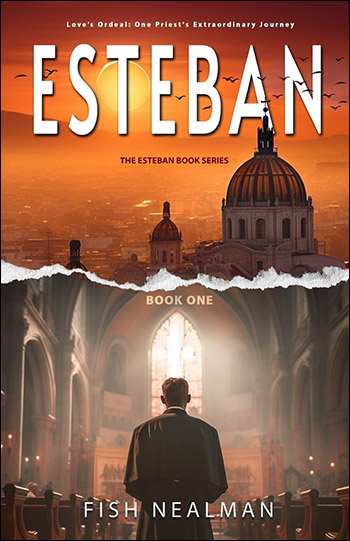
Tell us about your book series and what inspired it?
The book series is called Esteban, and it’s currently three volumes. Book one is subtitled Love’s Ordeal, the second Love’s Irony, and the third is Love’s Triumph.
From that naming, it becomes evident that love is an underlying thread transcending and interconnecting these books.
The series centers on a single protagonist. However, the story begins with his parents but swiftly shifts its focus to the protagonist’s life and experiences. My inspiration stems from my work, life, and observations of how people influence one another in relationships and the complexities of the human condition.
Typically, there is an expectation that people are highly motivated to achieve their goals. However, I wanted my protagonist to accomplish remarkable feats without an inherent drive for success.
Esteban is about a remarkable individual who tries to find love while struggling with loneliness and a mental illness. There are many twists and turns along the way.
In book three, Esteban finds himself in the Vatican, and after the Pope dies, the College of Cardinals appoints him to be the next Pope. Through his schizophrenia, he hallucinates Jesus, who tells him to decline the opportunity because he has more important things to do. The rest of book three then highlights the wonderful things he accomplishes.
The one point I want to stress about his mental illness is that Esteban is undiagnosed. This means that he doesn’t even know he’s schizophrenic, and none of the characters around him are aware, either.
One of the unique aspects of this series is the only person who is ever cognizant of his schizophrenia is the reader. By reading the series, not only do you come away with the enjoyment of a great story, but you also know more about the story than any of the characters.
How did you come to write the series and what personal experience did you draw on?
The truth of the matter is I’ve only written nonfiction technical books in the past. I had a friend who reached out to me, I had edited a historical novel of his, and he asked if I would be interested in co-authoring a book with him.
It turned out that he wanted to write a story that was based on his father, who had been a New York City police detective in the 1960s and was involved in a number of high-profile cases with the Mafia.
I didn’t know much about his father, so I put together some writings to show him my style. After I did that, I got a call from him, and he said, “I decided against co-authoring with you. Thank you. Goodbye.”
My wife turned around and said, “Well, screw him. Write your own story!”
Can you describe your writing process?
Primarily, it’s scheduled around the other work that I do. One of the things I found when I was writing nonfiction, which dealt with complicated technical issues, was unless I could carve out several hours, it was challenging for me to get into the mindset and go back to where I had left off.
I’ve found it quite the opposite with writing fiction. I could write something meaningful even if I could only grab five minutes here or there in addition to longer spells.
I don’t have a fixed routine of waking up in the morning and writing until the evening, or writing uninterrupted for three hours, or trying to finish six pages. I’m not methodical like that because of the other things I have to work on.
When writing fiction, I just try to grab every spare moment I can to create the story.
What do you want your readers to feel after reading your series?
I tried to write a story that had a compelling ending and felt satisfying. I wanted to create a story that, from the books I had read, wasn’t retelling a story I knew was out there. I wanted to create a unique story.
When people read my books, I want them to feel the time they put into reading it was worthwhile, that they enjoyed the narrative, the unique aspects of the story, and were satisfied with the ending.

Do we know what led to Esteban’s schizophrenia?
From a medical standpoint, what causes this in people has not been proven. It could be environmental, it could be genetic, or a combination of the two. When Esteban was born, his father, Stephen, wanted the child to be named after him. Stephen was American, and his mother was born in Mexico.
His parents had a very dysfunctional marriage, so at his birth, his mother was in a furious and vengeful state. She eventually decided to name the child Esteban, which is the Spanish equivalent of Stephen. She saw it as a way of getting back at her husband.
This caused her husband not to feel connected with his child, eventually leading Esteban to feel abandoned by his father. In turn, his mother was very overprotective, and there was always an aspect that he really wanted his father’s love.
The story stresses that his father made him crazy, and his mother made him perfect. Between the two of them, they made him perfectly crazy. Then, coupled with that, he had a traumatic experience with his first attempt at romance that led him to join the priesthood and enter the seminary.
He really struggled, and he got highly depressed with his loneliness and struggles at school. He was feeling suicidal, which leads to the reader’s first observation that he has a mental illness.
Is the main character Esteban motivated or driven to accomplish anything?
Esteban is very ordinary and not motivated directly. He’s honest to a tee and hardworking. In a traditional hero’s journey, the protagonist is presented with a need to overcome, tackle, and resolve a problem. That desire to resolve becomes the protagonist’s motivation. The trope is designed to pull the reader along for the journey.
Esteban is not driven or motivated to accomplish or resolve anything. Therefore, there’s nothing to pull the reader along when backdropped against the traditional trope.
Therefore, to pull the reader along, a book requires strong characters, “phenomenal” writing, and a compelling storyline. This is Esteban!
In addition to the fact that it’s only the reader who knows about his schizophrenia, the story breaks the traditional trope, and as far as the story’s time period, the 80-year journey (over the three books) is always read as if it’s happening today.
Those are some of the differentiating elements that I sought to include.
Is there any special superpower or ability that Esteban has?
Esteban’s one superpower is that he’s good with languages. He speaks multiple languages and finds it relatively easy to learn a new language.
Are there multicultural aspects to the story?
Esteban is Hispanic, with his father being American and his mother being Mexican. The story in terms of countries predominantly takes place in the US, Mexico, China, India, Italy, Spain, and Germany. It will take the reader around the world.
What would you describe as the tone of the story -- serious or humorous?
It’s a very serious story, but it also has elements of humor. I was born in London, however, my post-college years have all been spent in America. The reader will definitely encounter some dry British humor. I tried to include it with some sensitive things. The stories in the book tend to be a little bit edgy.
I’m not trying to offend people in any way. Even though Esteban is a priest, it’s not overtly a religious story in any way. The books won’t make anybody try to turn away from religion, and it won’t try to convert them either.
There are some serious undertones, obviously, even dealing with topics of depression and suicidal thoughts. At the same time, I try to give some levity and provide some elements of humor so readers can enjoy the story.
Do you have any advice for those who would love to write a book, but have full-time day jobs?
Don’t worry and go for it! I know that people have different styles and unique things that go with how they decide to write. While I had some ideas with Esteban when I started writing it, I didn’t know how the story was overtly going to end. I didn’t make that a dependency I needed before allowing myself to start writing.
So, I would say that if you’re writing and have other work to do, just start to create. Start to put words down. You can always revisit something you’ve written, but you don’t have to come at this knowing the complete story in your head. You can be organic.
As you get into the realm of the process, it can be fun, and hopefully, you’ll find yourself enjoying it.
After a while, you will begin to learn about your characters. They will start to tell you what they want to do next and how they want to be related within the story.
So always have fun, but don’t create a situation for yourself that you must know everything from the start. You can have aspects of self-discovery that keep pulling you along and motivating you to complete the book.
Who would you cast as the lead characters of your book if it were a movie or tv show?
With Esteban, I’d cast him with a Hispanic actor. I think that would certainly appeal to a broader audience and make it easy to have it sold internationally.
In the priesthood in book three, Esteban has the ability to speak many languages and gets offered the job in the Vatican to be a translator for the Pope.
Within that, I’ve created the Pope’s inner circle of Cardinals who are from all over the world. I really tried to create a story that includes people from all walks of life, all cultures and countries have a representation.
Do you have any other projects you wanted to talk about?
The third book in the Esteban series is out in August. Later this year, I will have a book called The Flat Tire, a story that happens in conjunction with what’s going on in the main Esteban story.
I just finished a book called Born Posthumous, which I hope will be published next year. It incorporates a lot of things that are going on with artificial intelligence in our world at the moment.
The Esteban series is a captivating tale and Fish Nealman is only just getting started at sharing his literary gifts with his ever-expanding audience of readers, providing compelling characters and complex narratives to entertain his audience for years to come.
He provides subversive narrative ideas while still providing compelling entertainment for his audience, as he knows, how it ends is often the most important part.
For more info, go to https://tales.fish
Home |
Actors/Models |
Art |
Books |
Dining
Film & Video |
Food & Wine |
Health & Fitness
MediaWatch |
Money and Business |
Music |
Profiles
Professional Services |
Sports |
Style & Fashion
Technology |
Theatre |
Travel & Leisure
Copyright 1995 - 2026 inmag.com
inmag.com (on line) and in Magazine (in print)
are published by in! communications, Inc.
www.inmag.com
|


Advertiser Info
Subscription Form
Contact Us
|

