














|

Hiding In Plain Sight:
Interview with Author Brian Brady
By Carin Chea
In recent years, the nation has ceaselessly focused on law enforcement with laser-sharp awareness, though that hasn’t dimmed the voice of retired police officer Brian Brady.
A proud native of San Francisco, Brady has lived the life that we often see on Emmy award-winning, primetime procedural dramas.
After having been exposed to notable cases like the Zebra Killers and the Night Stalker, Brady’s career transitioned to the field of corporate security until he finally adopted the role of author about four years ago.
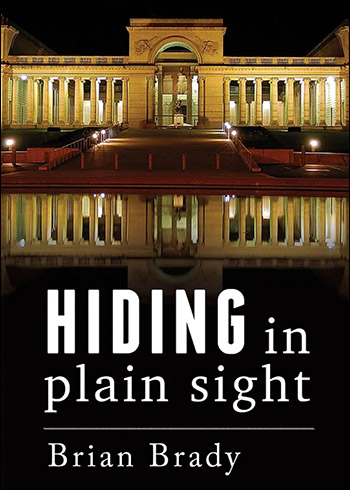
His recent book, Hiding in Plain Sight, is as gripping as it is sobering, especially as readers remember that Brady’s books are accurate and straight from the source, not sensationalized ripped-from-the-headlines entertainment.
What made you want to start writing?
My jobs in law enforcement and corporate security required writing, but that was different. That involved technical reports, and things like operations plans for the Oscars and Emmys. Because of the jobs and the different places I’ve worked, I’ve come across some great people and great stories.
When I would share these stories, people would say, “You should write that down!”
So, when I retired, I sat down and put all my notes together, then tried to build from real characters that could fit the stories.
I’ve got two books published now and working on a third one. You have to have a thick skin in this writing world. You send 25 pages off to your editor and they send back 26 pages of corrections.
It's been fun. Keeps me out of mischief.
I heard you worked on some famous cases, like the Night Stalker and the Zebra Killers. Are you allowed to talk about those cases?
I know the people who worked on those cases. Where I worked, in Berkeley, we handled fewer cases than in San Francisco. On my days off, I’d go to San Francisco and was a fly on the wall.
They were kind; they let me read the reports, go to crime scenes, and sit in on interviews. They were my teachers and mentors.
It was an opportunity to learn. One of the inspectors in San Francisco, and I grew up on the same block. He was a great source, and he was probably the most instrumental in giving me that opportunity.
He would do an interview and it was never an interrogation; it was just a conversation. When the conversation was over, you could pack your toothbrush because you were going to jail. Jack Cleary is his name. He’s 90 now.
Are you comfortable sharing one of the most memorable cases you’ve had in your police career?
One was the murder of a 13-year-old which the book is loosely based on. She was kidnapped and murdered. That’s the lead-in to the story, though in the book the killer is a serial killer. In real life, he got caught the first time. Those are difficult cases.
Sometimes people portray homicide detectives as very hard-boiled, very just-the-facts men. Those people who work homicide take these things very personally, not to the point where you can’t function, but they’re very concerned and connected to the victim, they care.
In the book, the young woman is the daughter of a firefighter, which emphasizes the family connection between the police and fire departments.
We’re very close to the fire department, which adds pressure on the investigators to solve the case, because the firefighters are family. Not to mention the additional pressure from the media in a child murder.
That all sounds so intense. How did you keep sane throughout your career?
You have to be able to shut it off. When you leave, you don’t forget it. It’s naïve to say something like that when you go to a scene where a child was murdered. You don’t forget that. But, you can’t dwell on it.
You’re allowed some relief because you can focus that energy on the case. You become very productive.
There are people whom it does get to; it does happen. Fortunately, times have changed. Fifty years ago, you climbed into a bottle and built a ship.
Today, there’s no stigma in seeking psychological help. It’s very accepted. Good supervisors in units like that, watch the people in the unit pretty closely.
If they think someone’s getting too involved, they’ll immediately say, “You have to talk to so-and-so and get your head right.”

What made you start writing in the first place?
There were a couple of cases in the first book [Oh, What a Tangled Web]. There was a guy who took women up to a cabin in the Sierras and would kill and bury them there.
It ties in with the issues of the sex trade and sex workers. The first book is a composite of three or four real issues.
Tell us about your latest book Hiding in Plain Sight. What do you hope your readers get from it?
It’s the second book in at least a three-book series and follows the same characters from Oh, What a Tangled Web.
I hope readers find some connectivity to the characters and they want to know more about them, delve a little deeper. I want a reader who wants to read slowly because they don’t want it to end.
I think Micheal Connelly is as good as it gets; he’s incredibly talented and prolific. He was also a reporter. He worked the crime beat. He has lots of connections in law enforcement, with access to hundreds of stories and cases. And then he built Harry Bosch. Harry is a series of books and is now a TV star.
Connelly paints great, vivid literary pictures. His characters are interesting, but not perfect. I like the character’s imperfections to be minor, and I’d prefer them not to be what you see on television, especially on the BritBox TV shows.
The hero is dysfunctional most of the time, either an alcoholic or a drug addict. I don’t know how they get to work each day!
That’s very true!
I’ve gotten to like my characters. You start living vicariously through them. Writing requires a certain amount of work.
I talked to Sheldon Siegel, a lawyer who lives in Marin County. He writes about Public Defenders turned defense attorneys in San Francisco. He tells me he gets up at 8 am and starts writing; it’s a job.
I’m not that disciplined. But, at the same time, it’s fun. It’s wide open. You can make your characters anything you want them to be. It has to flow, but you have such an incredible license to have fun with it.
But, back to the book: There’s a piece of evidence that would implicate this person, which is back in an evidence locker on the East Coast. It was collected, but the piece wasn’t necessary for that case.
Rather than getting entered into a bigger system, it sat on a shelf. That can happen, you know. I wanted to take that and expand on how it's rediscovered. The story unravels for the bad guy once that piece of evidence is unearthed.
I also enjoyed the relationships between the detectives. I use the popular NYPD term “breaking someone’s balls.” That’s just partners giving each other a hard time. There’s nothing evil about it; it’s just good-natured. You’re fair game at any given time.
Two inspectors get introduced in the first book who carry over into this book. Add the female inspector – and she’s equally adept at dishing it out. That part is fun because it adds a lighter element to an otherwise serious plot.
Who would play your protagonists if your book were to become a procedural drama on prime-time TV?
I’ve thought of that. The trouble is, as you get older, the Hollywood actors you relate to are going to be too old to play the part. It’s not great if your heroes have an oxygen tank and a walker.
I’d gravitate toward Edward Norton. I think he can play anything.
Do you have any upcoming projects you’d like us to know about?
The third book I still have to name.
I have a folder of ideas and excerpts that struck me as humorous or intriguing. I’ve developed in my head the antagonist in a fourth book that’s separate from the book series. I’ve done such a meticulous job with this bad guy that now I don’t know how to catch him!
I’ve painted myself in a corner with this guy. Or, maybe he won’t get caught and that might lead to another book.
For more information, please visit www.GoldenGateTales.com.
Home |
Actors/Models |
Art |
Books |
Dining
Film & Video |
Food & Wine |
Health & Fitness
MediaWatch |
Money and Business |
Music |
Profiles
Professional Services |
Sports |
Style & Fashion
Technology |
Theatre |
Travel & Leisure
Copyright 1995 - 2026 inmag.com
inmag.com (on line) and in Magazine (in print)
are published by in! communications, Inc.
www.inmag.com
|


Advertiser Info
Subscription Form
Contact Us
|

