















|

Trust in the Process: Interview with Sheldon Eskin, Esq.
By Carin Chea
We're all familiar with the age-old saying coined by Benjamin Franklin, "In this world nothing can be said to be certain, except for death and taxes."
Unfortunately, many of us shy away from addressing certain subject matters, despite their inevitability.
Like, for instance, how to handle your finances and assets in the event you're unable to make decisions independently. Who will you appoint as a trustee?
Will your beneficiaries (especially if they are disabled children) be taken care of following your passing?
Sheldon J. Eskin, founder of The Law Offices of Sheldon J. Eskin, based in Glendale, CA, understands the complexities of these delicate and often confounding topics.
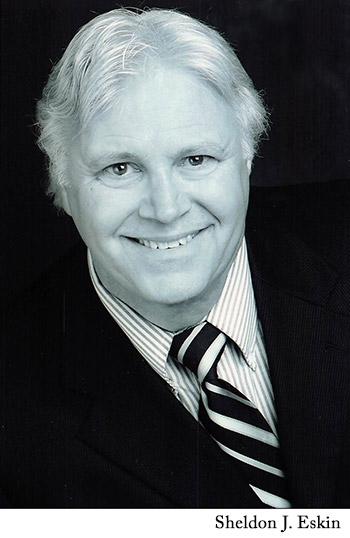
Eskin has impressively diverse credentials that include decades-long involvement educating and assisting the community with trusts and estate planning. With deeply personal roots in the matter, Eskin goes above and beyond basic estate planning.
Eskin carefully crafts individualized care plans for his clientele, assuring that they, and their generations to come, can live in peace and assurance.
You have a very impressive history, and you're very rooted in the community. How long have you been doing this?
I've been doing this for a long time. I was the president of The Glendale Advisory Board of the Salvation Army up until recently. I was the vice president of the Glendale Friday Kiwanis, which has been around for 100 years.
I was also president for The Glendale Bar Association as well as other organizations and currently a member of the Woodbury Business Institute Advisory Board (Univ. Of Redlands, Los Angeles).
I have a feeling you'll never truly retire. You'll be active and sharp forever.
My idea of retirement is to be able to come into the office at 8 or 9 am, eat lunch, and decide whether or not to go back into the office or go to the club and work out. I just can't sit around and do nothing.
I hired somebody once, and he was very knowledgeable in his area of law. He had been retired for ten years or so. He said he wanted to be with his grandkids, but he got bored and said he wanted to work for me. He just finished his last case. He's 90 now.
Wow! It sounds like you and your firm are truly passionate about what you do.
I have an autistic child, Gabe, and it is extremely difficult to navigate and understand what really has to be done.
The problem is that people, especially those with young children, will come across insurance salesmen who will sell you the wrong product, like term insurance, which provides financial protection but only for a specific period of time.
Term can be used really well for a supplement to a whole life policy or a universal. But, just having term, if you don't die by 11:59pm on the night before your 75th birthday, your premium will be so high you may not be able to afford it.
I always ask my clients if they have anyone (kids or beneficiaries) who has any disabilities. Something like one out of thirty-six people is on the autistic spectrum. That's high.
I can see why you're personally invested in this matter. I understand your specialty are special needs trusts.
In general, when I'm talking about a third party special needs trust, I call it a supplemental needs trust. If you have a first party special needs trust, I just call it a special needs trust.
What's the difference between those two?
A third party trustee is set up by a third party, not the beneficiary themselves. Mom and Dad as the creators of the trust can do the trust as a sub-trust of, for instance, mom and dad's trust. Or, they can set up a stand-alone third party trust.
So, let's say mom and dad create a trust for "Billy," their son and beneficiary. When they do that as a stand-alone, and other relatives want to put money in that trust for Billy, they can.
Now, if Mom sets up a trust which says, "When I die, Billy will get a million dollars," mom didn't set that up right. In order for Billy not to lose government benefits, Billy can set up a first party special needs trust so he can protect the funds.
Can you tell us more about third party special needs trusts?
It is a legal agreement that holds assets for someone with a disability without disqualifying them for government benefits, like Medi-Cal in California or SSI (Social Security Benefits).
These assets belong to someone other than the beneficiary. The core principles of a supplemental needs trust is that it pays for things the government programs do not cover.
The assets in a supplemental needs trust are not owned by the beneficiary; they're owned by the trust. There's a limit the beneficiary can have in his own personal bank account or hold as cash.
Who needs a special needs trust (or third party special needs trust) and why?
Almost everybody who has a disabled child needs one. The parent setting it up is not going to be here forever. If you set up a special needs trust for the disabled person, there will be funds available, and it'll also appoint a person to manage the trust when you are no longer here.
If you have a person who's disabled, try to figure out how much money it's going to cost to live in a group home, or have a caregiver with them if they live by themselves.
Depending on the severity of the disability, it can cost a fortune. You've got to be careful when setting it up; you can't just depend on AI for this. You can't simply say, "I'm going to leave a million dollars to my son."
If you leave the assets directly to the disabled person in the Will, that can disqualify them from government benefits. The beneficiary is limited to what they can own if they do own anything, it's restricted, otherwise, it will affect their SSI benefits.
The trust is the owner of the property, and the disabled person is the beneficiary. The trust is held for the benefit of the disabled person. That way, they have access to resources through the trustee, but they (the disabled person) can't technically own it.
What can a trust pay for?
On a third party trust, depending on how its written, it can pay for almost everything. It also depends on how much money is in the trust.
For example, including but not limited to, it can be used for health maintenance and welfare, education, and you can buy musical instruments, televisions, an automobile of any value, etc.
But, for instance, if "Billy" wants to go on a vacation and take a companion, you can do that in a third-party trust. It is different in a first party trust; it's really only for the beneficiary but the beneficiary is entitled to take an assistant along when traveling.
A third party trust is super open. You have to look at the trust itself as a bible, telling you what you can and cannot do. I try to make it as open as possible. The lists can go on infinitum.
You really don't want the trust to pay for shelter or food, because that's what the SSI benefits are paying for. The trust is funded by family or others, and no Medi-Cal payback is required.
First-party vs. third-party trusts - can you go into further detail about their differences?
First party trusts are funded with the beneficiary's own assets, like personal injury settlements or an inheritance.
The first party, for instance, is when "Billy" inherits money directly. It's his money, but he needs that money protected in a trust because he still needs government benefits.
Billy doesn't own the money; the trust owns it and Billy is the beneficiary Medi-Cal payback is also required.
The third-party standalone trust does not include the assets of the beneficiary. Basically, anyone can contribute to the third-party trust.
Its set up with mom and dad's money (for simplicity's sake). They're putting it into the third party trust and it is a revocable living trust, meaning mom and dad can change or terminate it.
How do you choose a trustee?
Let's say mom and dad die. They need to appoint a successor trustee who will have fiduciary responsibilities. The investment management, record-keeping, benefits coordination and distribution - it's all in the hands of the trustee.
You can pick a family member or a professional trustee, or a combination of both. But, don't ever do something like, "Billy's brother will have all of the one million dollar inheritance." His brother might decide that he'd like a new car and use Billy's money irresponsibly.
What are the most common mistakes and pitfalls people make?
1) Leaving assets directly to a person with disabilities in the Will. That disqualifies them from receiving government benefits.
2) Naming the disabled person as the direct beneficiary of a life insurance policy.
3) Failing to update your trust after major law changes.
4) Poor trustee selection.
What is an ABLE Account
Not every state has an ABLE [Achieving a Better Life Experience] account.
In California, it's called a Cal-ABLE account. It's the account a disabled person can have in their own name. As of January 1, 2026, you have to be under 46 years old to set up an ABLE account.
You can have up to $100,000 in the account. After that, you have to spend down. If it goes over that amount, your SSI will probably be diminished or temporarily suspended.
Also, anybody can put into it, not just the disabled person.
Previously, if the disabled person died with money still in their account, the government would "claw back" and essentially take the money back that's owed to them.
That is no longer the case with Cal-ABLE accounts.
How does one know if they should have an ABLE account or a special needs trust?
You should have both. The Cal-ABLE is not a trust. It's a vehicle, especially if the disabled person can work.
How does one get started to plan for a special needs trust?
You really have to have confidence in the person who's doing the work for you. If a client calls me, I try to get back to them the same day.
I believe all trusts are necessary, but special needs trust are so important. Everything is tailor-made.
It is really important to hire an attorney that understands these types of trusts.
Disclaimer: This is not intended as specific legal advice but for general information purposes only. These situations are complex and it is recommended that a suitably qualified attorney be consulted on these matters.
For more information, please visit https://eskinesq.com.
Please note: The correct address for The Law Offices of Sheldon J. Eskin is 655 N. Central Ave., 17th Floor, Glendale, CA 91203.

Home |
Actors/Models |
Art |
Books |
Dining
Film & Video |
Food & Wine |
Health & Fitness
MediaWatch |
Money and Business |
Music |
Profiles
Professional Services |
Sports |
Style & Fashion
Technology |
Theatre |
Travel & Leisure
Copyright 1995 - 2026 inmag.com
inmag.com (on line) and in Magazine (in print)
are published by in! communications, Inc.
www.inmag.com
|


Advertiser Info
Subscription Form
Contact Us
|
